It’s early August, and we’ve just landed in Kigali, Rwanda, to kick off the Next Generation Africa 2023 bootcamp. An intense week of meetings, mentorship, and debate awaits us with some of the most promising startups from East Africa that have applied in large numbers to participate in this year’s programme.

We arrive early in the morning when the air is still fresh but already taking on the warm, brick color of the earth. In Kigali, when you enter the city, there’s one thing you notice right away.
The streets are constantly buzzing with fiery red motorcycles that zip through traffic and offer rides at a good price to anyone by the roadside. They’re called motós here, and they’re perhaps one of the most representative images of a country in motion like Rwanda, seeking its own space in the Africa of innovation. It doesn’t take us long to get carried away by this energy, and just a few hours later, we too are aboard the motós, touring around.
The market, the memorial of the terrible 1994 genocide, the downtown streets: we move with the wind in our faces and begin to map out the geography of the city. Alongside a vague geographical map, each of us begins to silently trace a very personal but precise sentimental map, born from the first encounters with the faces, colors, and smells that inhabit every place we reach.
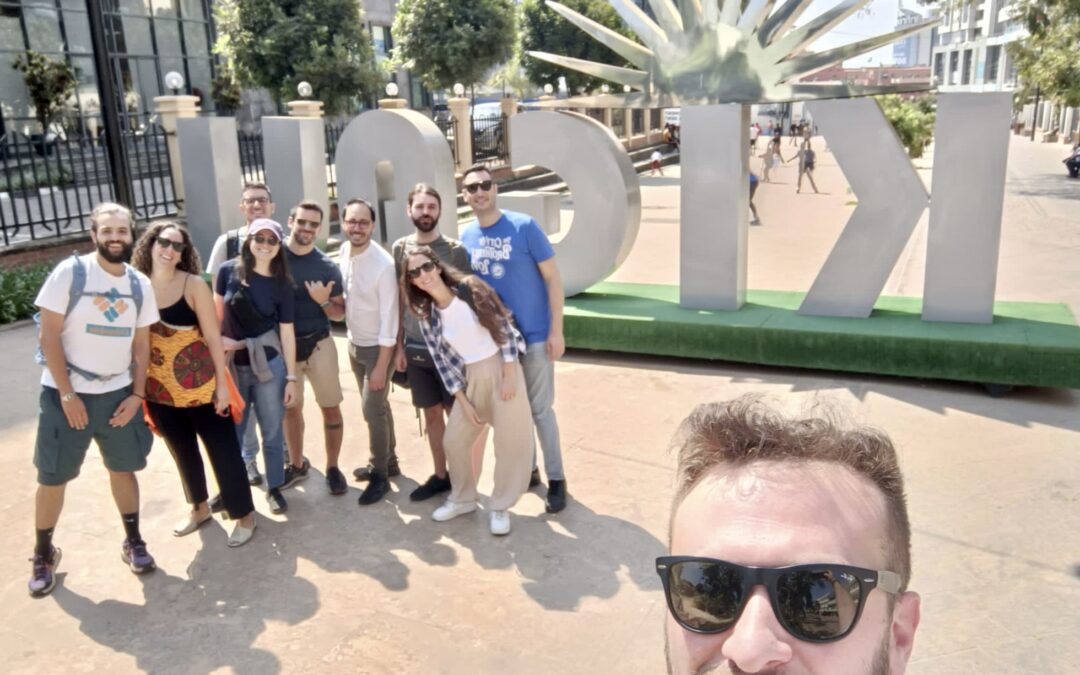
As we get to know the city that welcomes us, we also get to know each other as volunteers, many for the first time.

I wonder what drove each of us—with our different stories—to come here, to Kigali, in the middle of summer, to work alongside entrepreneurs so far from our country. Looking closer, I realize that we are indeed strangers to each other, but we all have something in common. I would say it’s a question – we’re looking for something. You can tell by the way we look around, how we talk to each other, and the stories we tell. And we probably believe that here, 5,185 km from Italy, this something can be found.
We begin on Monday. We are in a place that is vying to become a hub for all of East Africa’s innovation, the beautiful spaces of Norrsken in Kigali, just a few steps away on foot from the hotel where we spend the night.

There are some things that strike me about these entrepreneurs, listening to them for the first time. They are all elements that will emerge more and more strongly during the week we will spend together. I’ll try to summarize them here:
- They know the problems they are trying to solve very well. Almost all the entrepreneurs we listened to started from a firsthand experience of the problem. Detailed knowledge of the real needs of users helps them to really start in a lean way, leading them almost naturally to optimize the resources available to quickly create a real and functioning product or service, to be made available to users—and thus solve their problem. Afia Pharma was founded by Papy Biganza precisely to respond to a serious lack of the Rwandan health system: it was 2019 when Papy’s grandfather lost his life because he could not receive adequate care and medication, living in a rural area of the country. After that experience, Papy decided to found his startup: an e-commerce platform for drugs, specialized in last-mile delivery, and equipped with a system to effectively support patients in adhering to therapy.
- There is no enterprise that is not also socially and environmentally impactful. Out of the 24 pitches we heard, at least twenty explicitly explained how the startup would contribute to achieving one or more Sustainable Development Goals (SDGs). Or at least they described what social and environmental impact they would have. In short, it is really difficult to find a startup here that is not natively and intrinsically ESG impactful. One example above all is Ecoplastile: founded by Franc Kamugyisha, Ecoplastile produces roof tiles and other building materials from recycled plastic. However, the heart of the startup is not the production of such materials, nor the simple recycling of plastic: Ecoplastile is a real platform that allows all those without stable employment to become “informal recyclers” of plastic and be paid for it. In some ways, it is the virtuous synthesis between the gig economy, environmental impact, and social impact.
- Climate change is taken for granted; the question is how to address it. While in Europe we still hear debates about the existence of climate change and we happen to hear prominent public figures declare that, after all, even if the climate is changing, it would be useless to reduce the environmental impact of human activities, here in Kigali these issues are taken for granted. The story of Coleen Bango and her Bango Hydro Farms starts right here: Coleen comes from a family of farmers and has seen the effects of climate change on the family farm. To innovate the way of farming and make the company sustainable, thanks to her studies at the African Leadership University (ALU), Coleen is now exploring the potential of hydroponic cultivation, and from there Bango Hydro Farms was born.
- Here, cooperation is as important as competition. Most of the startups were there to take home something that would really be useful for solving their own problems, both from the group of mentors and from the other participating startups. No race to excel, but instead a strong desire to create synergies and learn from those who are already a little further ahead.
The night before, Patrick tells us: “Don’t forget, I’m expecting you tomorrow morning at 6:30. At that time we start with the Morning Coffee Therapy.”
The next morning we are late, but at least we are on the road. We are going to see with our own eyes what Patrick has created in the last two years. Two years of work, desires, vision concentrated in a physical place, which, however, is only the starting point of a project with a much greater potential. ☕
A powerful image greets us when we arrive. The motós have taken us up a hill on the outskirts of Kigali, overlooking the city from above, lit up by the warm morning sun. At the end of the road we are now walking on, behind a large open gate and just before the ridge of the hill, there are some buildings that surround a square of ground with an irregular perimeter. The One Ounce Café is a light structure of wooden planks, which serve as floor, walls, counter, and shelves. A small temple of coffee.
As we approach, we see five backs leaning on as many stools, looking towards the counter and beyond, sipping coffee. Afterall, right behind the counter, there is the spectacle of Kigali getting ready for a new day. And in front of this beauty, among coffee machines of unknown shapes and intense aromas, there are young girls and boys moving with ease and with a welcoming attitude. Patrick rises from one of the stools and comes towards us smiling – perhaps he had some doubts about our ability to keep the time commitment, but now we’re here.

Patrick introduces us to the guests enjoying their coffee, the girls and boys running the bar, and lets us try a type of coffee preparation they invented, mixing coffee made with a traditional Rwandan method with passion fruit, ice, and a few other little secrets. Delicious. As we sip and wander among those fascinating machines, Patrick begins to tell us more about the story behind his startup, 1 OZ.
Patrick is one of those entrepreneurs who literally started from scratch. In fact, he had to build the scratch from which to start. After school, he tried to find work as a barista. No one would hire him because he had never been a barista before. So Patrick decides to learn the trade by studying on YouTube. He trains in coffee preparation techniques, becomes good at it, tries again to look for work: no luck, he doesn’t have enough experience. So Patrick decides it doesn’t matter: he fixes up the ground floor of his family home and turns it into a coffee school for anyone who wants to learn the barista trade. Unemployed girls and boys start to take an interest, and the project grows.
Unemployment here in Kigali is a big social problem. So under Patrick’s house, they study together, learn together, and at some point, work together: that’s how the first Café is born, to give students the opportunity to practice on one hand, and on the other to generate income to support the school and the students’ journey. A community begins to form. Many of those who finish their studies go to work abroad – Middle East, Europe – and often continue to support the school. Two friends of Patrick, who have a tiny art gallery and sell souvenir items, suggested opening his cafè in this square where we are today, right next to their gallery and the souvenir shop.
Patrick also tells us about his dreams – and the reason why he participated in “Next Generation Africa”: now that he has seen the enormous impact his project can have on the lives of his peers and the increasing demand for the school particièation, he would like to create an even bigger Café and training center, and develop this area of the city. We encourage him in this direction, but we also invite him to take an additional step. ☕🌱
Let’s start with some simple questions, but ones that help us go further: what are the real problems that Patrick solves by teaching how to prepare coffee? What is the real value proposition of 1 OZ? And how can technology become an enabler to have a greater impact, on a larger scale, and perhaps even stimulate other investors to join the project? We have been pondering this for days with him during the bootcamp, and although it is not easy, some interesting ideas are emerging.
We reflect on this also on that morning, while in front of our eyes we no longer have only slides and excel sheets, but a place that smells of the future and of people who wake up every day to work on that project, identifying with those values, knowing that it can become an extraordinary adventure of individual and collective emancipation.
We would never leave, but there are the other 23 startups waiting for us and it is almost time to start the bootcamp of the day. But before we leave, as we say goodbye full of gratitude for the vision that those girls and boys have shared with us, something magical happens.
We look up at the wall behind the counter and Davide, a volunteer friend, notices a writing next to the logo of the One Ounce Café that says: “We create a community of capable youth who not only find work but are also capable of creating employment for others.”

Bingo. There it is, the heart of the value proposition of 1 OZ that we were trying to define, encapsulated in that perfect sentence that gathers all the meaning and all the potential that Patrick’s project has to make its impact even more disruptive.
We didn’t have to do much to find it: we just had to lift our heads from our computers, come all the way here to see and have a coffee. ☕
In the following days, the bootcamp continues swiftly. Every now and then, we could use a coffee from Patrick, but even though we don’t have it here, the energy of the One Ounce Café has stayed with us, and there’s the great enthusiasm that we generate every day together that keeps the gears turning well in our heads.
We keep going. We will end with the Demo Day and it will be a success, I know.
The Demo Day was indeed a success. It was tough to select the startups that will come to Italy in the spring of 2024, but in the end – also thanks to the precious experts and jurors involved – we managed to make our choice. However, we hope to stay in touch with all the startups, and we hope to find creative ways to do it well.

Meanwhile, now it’s Saturday and it’s time to leave. We head to the airport, this time the brick-colored soil is already in the air and seems to want to greet us by holding us a little tighter. Checks, passports, small queues: the routine is the same as in all airports around the world, but that small structure with just three gates is no longer an unknown place. We board and take our seats. One last look outside, to fill our eyes again. Then the flight takes off and our eyes close. We return to the warm Italian summer.
Back in Italy, a couple of months later, I happened to exchange a few words with Allan, a Kenyan entrepreneur who came to Milan for some exchange activities organized by BeEntrepreneurs and ENI, as part of the joint initiative “Seeds for sustainable energy 2023“.
We were at a reception and I was struck by the words we parted with: “Training and coaching are great. But what we really need is to transform this education into knowledge, and knowledge into wisdom. It takes time, long-lasting relationships and continuous cooperation, but it’s what we need to build our future.”
Allan was clearly talking about his future as an entrepreneur, that of the startup ecosystem in Kenya and – probably – also the future of his country. But I believe that in this sentence he was also speaking a bit about us, Italians and Europeans, who perhaps have not yet found a recipe for our future.
Allan was telling me that to build something that lasts, and that thrives and has an impact, it is necessary to take an extra step, to go beyond an exchange of information, resources, knowledge, and instead dedicate ourselves to building relationships. Relationships that last and amplify the scope of the individual exchange, that give us space and time to cultivate a bond of trust and, ultimately, of care.
So probably that’s what drove us to go all the way to Kigali, in the heart of Rwanda, 5,185 km from Italy, 6,208 km from the center of Europe. The bet that there we would find not something, but someone who continues to cultivate a desire for the future, and to do so takes care of the present, to ensure that this future – when it arrives – is truly up to everyone’s expectations.
In short, we knew that in Kigali we would meet a piece of another story, which however – if we want – can also become a piece of our own.
Click here for more information on “Next Generation Africa 2023“.





Recent Comments